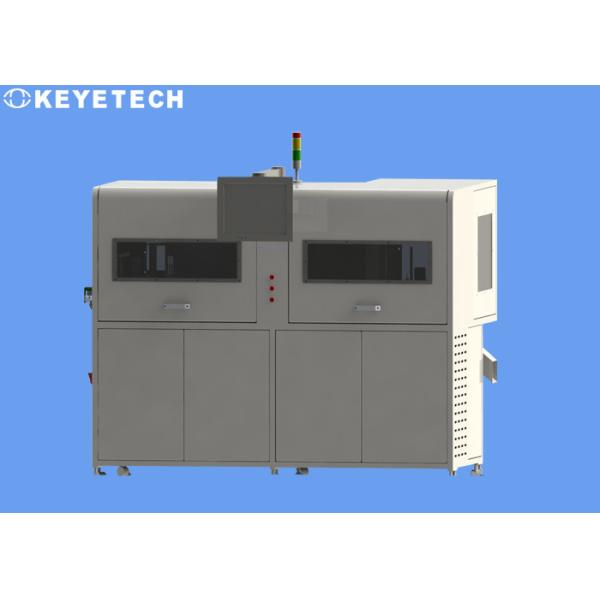
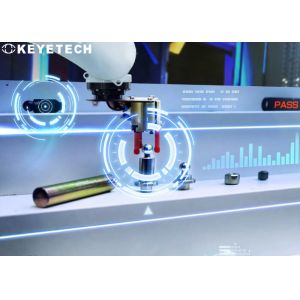
Industrial Automation AI Visual Inspection System With Deep
Learning Algorithm
Equipment Features
| 1. AI algorithm: high stability, adapting to the environment and
background disturbance; different defect samples can be
automatically identified after training |
| 2. Dataization: Independent database, save multiple samples,
analyze non-good products, and retain history |
| 3. Multi-orientation: 360 ° comprehensive inside and outside the
samples |
| 4. High precision: detection accuracy can be high |
| 5. Modularization, can flexibly increase or decrease the detection
function according to customer actual needs |
| 6. Easy to operate: It is easy to operate and easy to maintain |
| 7. Safety: Medical grade material manufacturing, fully compliant
with medical supplies production environment |
The value of AI visual inspection
- The value of artificial intelligence is particularly evident in
visual inspection. AI-based visual inspection technologies are
improving manufacturing business operations.
- AI-based visual inspection relies on two strengths of AI: computer
vision and deep learning. Every AI system has a core capability to
sense its environment and act on those perceptions.
- AI can adapt to various environments through deep learning, making
it applicable to a wide range of industries. It has unlimited
potential and can be developed quickly to meet the needs of
manufacturers.
Principle of visual inspection
Just like the human eye can detect defects, a well-trained AI
vision system can do it, and with greater efficiency. An AI-based
vision system captures images and sends them to a central "brain"
for processing. The AI "brain" arrives at a detailed meaning by
comparing the images with existing knowledge.

An AI-based vision system consists of these two integrated
components: the perception device acts as the "eye," and the deep
learning algorithm acts as the "brain." The integrated system
successfully mimics the ability of the human eye and brain to
interpret images.
AI-based vision systems are more efficient than human eyes because
the AI "brain" stores more information. Powerful computing power
can quickly parse the available data. The system can classify
objects in photos and videos and perform complex visual perception
tasks. Such as searching images and captions, detecting objects,
recognition and classification.
Hardware:
- Camera: We use our own developed camera (the chip is from Japan),
which has clearer image recognition and is more compatible with our
own software.
- Light source: We have a dedicated optical team to develop various
light sources to adapt to the optical scene requirements of
different industrial scenes.
- Embedded computer: The KEYE team independently developed the
embedded computer NPU computing box, which replaced the traditional
PLC industrial computer; it is not afraid of sudden power outages
and high temperature scenes, and can better adapt to the high
temperature environment.
Software:
- Algorithm: We use the latest AI deep learning algorithm. Most
products only need a small amount of sample learning to complete a
new product model; the machine can continuously learn some defects
and good samples like the human brain, making the detection effect
better and better.
- Software: The latest KEYE V16.0 software can realize a variety of
data statistics and human-computer interaction functions, and the
touch screen operation is simpler.
- KEYE cloud platform: The AI cloud platform can create its own cloud
platform account for each customer, and the pictures of each
training operation will be saved in its own account; even if the
algorithm is lost due to software algorithms or other problems, all
previous data can be retrieved through an independent cloud
platform account. (KEYE team has technicians who regularly maintain
this platform).
- After-sales service: Provide long-term remote service, customers
only need to keep the device in good network connection.
Delivery Time
The production cycle of the whole machine is expected to take 60
days. If additional inspection requirements are added or more
adjustment needed, the time will be appropriately extended
accordingly. After the equipment arrives at the customer's site,
our company arranges after-sales personnel to complete installation
and adjustment at the customer's site.
After Sales Service
- The seller should complete the creation and debugging of the
product basic algorithm model before the equipment is shipped, also
provide remote assistance after the equipment arrives at the
customer site; and provide buyer with the factory data and
operation manual of equipment.
- Daily operation and maintenance services: Our company provides free
remote operation and maintenance online services. If you need to
upgrade inspection algorithm, provide operational assistance, etc.
- Our company have regular offline training plan every year, so
domestic and foreign clients can send their engineers to
participate (at their own expense). Those who pass the exam can
obtain an industry functional skills certificate.